About Continuous Dryer
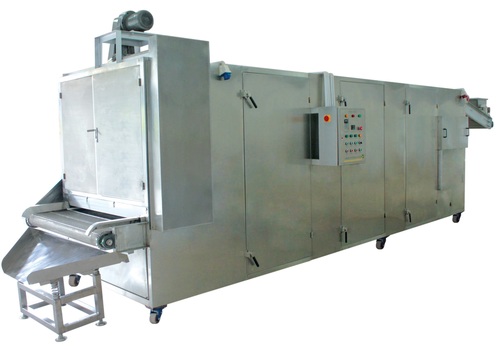
A continuous dryer is an enclosed drying machine that can be used in all industries where products are to be dried in no time. The product to be dried is fed through the inlet valve and dried product is discharged through the swivel valve discharger. Hot air is pulled through product bed and once the job is done the maximum volume of dryer air is recirculated back into heater. The operator can control the open and closed position of the discharger manually or by using a control system.
Contactparts are food grade.
Standardparts ensure long life.
| Conveyormotor | 3 HP, |
| BlowerMotor | 0.5 HP, 04 nos. |
| HeaterLoad | 30 Kw. |
| Length | 20 feet. X 5 layer = 100 feet. |
| ProductionCapacity | Up to 350 kg/h |
| MO C | Mild Steel |
| MO Belt | Stainless steel with mosquito net |
| Electricsupply | 415 V 50 Hz 4 wire |
FiveLayer Dryer.
Advanced Control for Seamless OperationsEquipped with an automatic PLC control system, the Continuous Dryer ensures precise management of drying parameters. Users benefit from easy operation, real-time monitoring, and consistent product quality, all while minimizing human intervention. Safety features like overheat protection and emergency stops bolster operational reliability.
Versatile & Energy-Efficient DesignDesigned to cater to various industries, this dryer supports multiple heat sources-steam, electricity, or gas-allowing adaptability to different environments. Its adjustable air flow and conveyor types (mesh belt, slat, or tray) accommodate a wide range of products, while the highly efficient system optimizes energy use based on capacity requirements.
Superior Safety & Customization OptionsBuilt with insulated hinged doors and safety locks, the dryer prioritizes user safety. Its dimensions and surface finish can be tailored per client specifications, making it a flexible choice for manufacturers, exporters, and service providers. The robust steel construction ensures durability and long service life.
FAQ's of Continuous Dryer:
Q: How does the continuous dryer operate and what makes it fully automatic?
A: The continuous dryer operates on an automatic PLC-controlled system, managing temperature, air flow, and conveyor speed without continuous manual supervision. Operators can set parameters and monitor the drying process through a user-friendly interface, ensuring consistency and high efficiency throughout each batch.
Q: What types of products can be processed using this continuous dryer?
A: This dryer is ideal for applications in the food, pharmaceutical, chemical, agricultural, and textile industries. Its customizable conveyors and adjustable drying configurations allow it to handle a broad spectrum of raw materials, ranging from granules to sheets and textiles.
Q: When is it most beneficial to use a continuous dryer over conventional batch drying methods?
A: Continuous dryers excel in high-volume, ongoing production settings where consistent moisture removal and process efficiency are critical. They are especially beneficial when processing large quantities of material, as they minimize downtime between batches and deliver uniform drying results.
Q: Where can the continuous dryer be installed, and what are its space requirements?
A: Intended for floor-mounted installation, the dryer can be integrated into new or existing processing lines in manufacturing facilities. Its dimensions, including length, width, and height, are customizable to fit specific site requirements, ensuring optimal use of available production space.
Q: What safety features are included in this dryer to protect operators and equipment?
A: Safety is prioritized with overheat protection, emergency stop buttons, and insulated hinged doors fitted with safety locks. These features are designed to prevent accidents, protect equipment from damage, and provide safe access for maintenance and operation.
Q: How does the dryer's adjustable air flow and multiple heat sources benefit the drying process?
A: Adjustable air flow allows for fine-tuning of drying conditions-either forced or natural convection-accommodating the unique moisture profiles of different products. The option to select from steam, electric, or gas heat sources provides flexibility in energy use and cost management, tailoring the process to specific operational needs.

 Send Inquiry


 Send Inquiry

 Send Inquiry